Across the Pyrenees along an abandoned railroad

Day 1 – Tuesday 25th of August – Barcelona to Saintes (782km)

8:30 am, not the best time to set off if I wanted to get as far as possible on the first day, but I wanted to drop Nat off at work and say goodbye before hitting the road, and her office is on the way out of Barcelona. Wanting to save some money, I had decided to avoid the coast motorway and I headed east towards Lleida and then Huesca. The only difference between the coast route and this one up to this point is that this one is free. Other than that, almost 300 km of boredom. Once past Huesca and on the way to Jaca things get more interesting, though.

I wanted to cross the Pyrenees through the Somport, one of my favourite passes. The road down the valley on the French side is amazing and the scenery breathtaking. Not only that, there is also the abandoned station of Canfranc on the Spanish side, and the train tracks and stations of the French line that used to connect to it on the other side of the border, as well as the Fort du Portalet. I did not have time to visit all of this again, but it is always nice to take a look.

The day was beautiful, but as I climbed up the southern side of the Pyrenees the temperature dropped, and by the time I reached the top of the pass it was quite chilly while on the move. It was already lunchtime and in my mind I had pictured having something to eat sitting at the top of the pass, gazing over the gigantic mountains all around me, but there was nowhere nice to sit other than a rather depressing car park, so I got on the bike and rode down to find a decent place to eat.

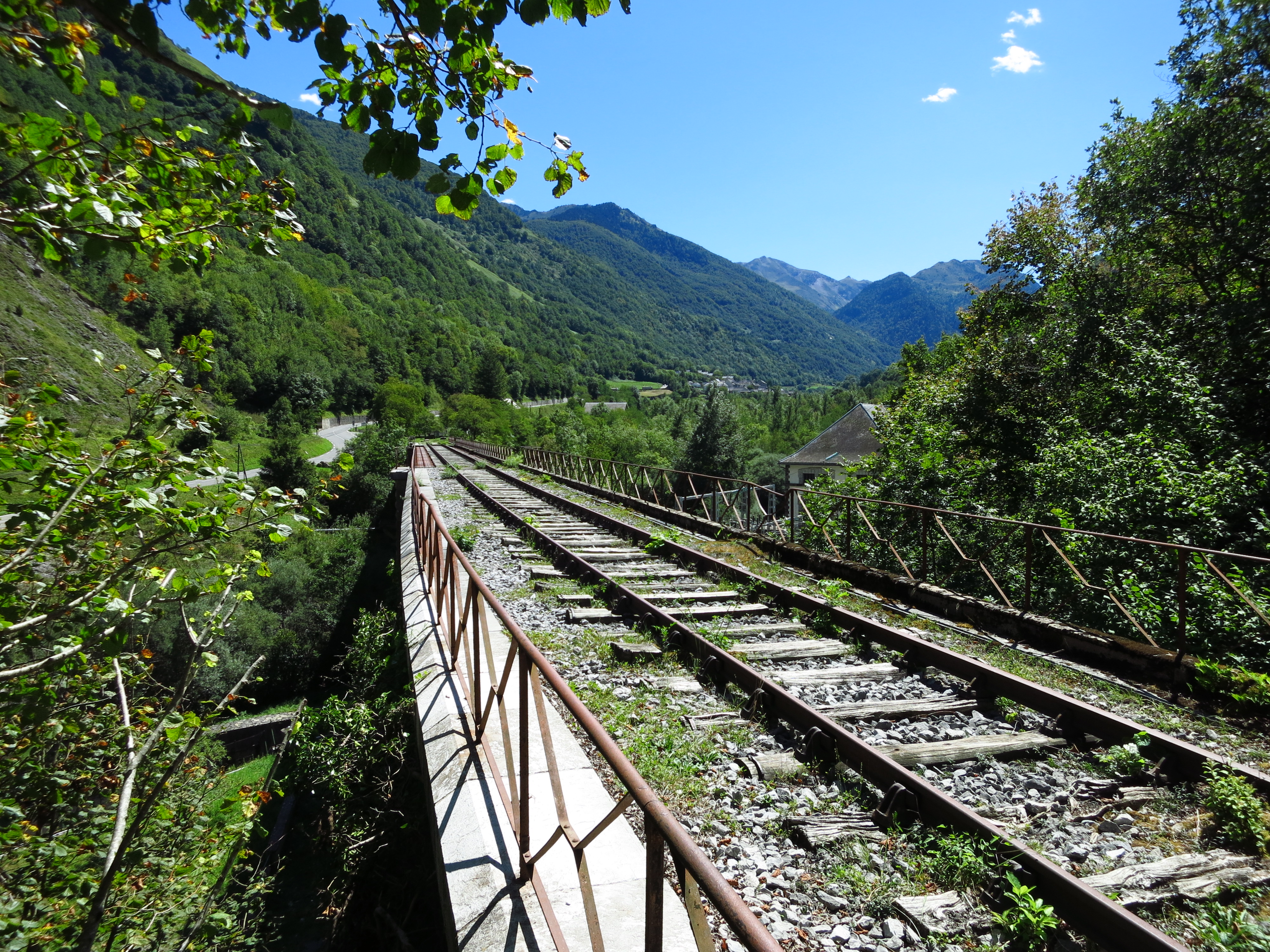
And as luck would have it, after passing a couple of spots with picnic tables but too many cars parked by, I found an empty picnic area in the perfect spot for a weirdo who likes exploring old places like me. Just past the tiny hamlet of Urdos there is one of the old train stations that someone has refurbished. It did not look like a bar, hostel, tourist office or any other of the usual things that old stations end up being used for, but rather a private residence. Strange. In any case, past the station and next to the old tracks, there was a nice picnic area, with a couple of tables in the shade of some ancient trees and a view of one of the old train bridges. There was even a tunnel on the other side!

IMG_5514

Obviously, after having lunch, and seeing that the access across the bridge and into the tunnel was not closed, I decided to explore a bit. The switches on the rails coming into the station were still intact, and even though they were very rusty, if you were strong enough you could operate them – I almost injured my wrist.

IMG_5508

The bridge was also all rusty, but the rails were laid on solid steel beams, and as long as I walked on the beams, not on the sheets of metal covering the gaps under the rails, there was no problem to cross the bridge. Below it ran a stream of water coming down from the snow high in the mountains and up ahead of me, the dark mouth of the tunnel.

IMG_5506

On top of it there was an engraved signed with the construction date – 1922, which reminds the adventurous visitor that the line only operated for 48 years. Despite having seen no maintenance since 1970, the tunnel was still in remarkable good condition, and I was able to walk quite far into it. It was not possible to see any light from the other end, so I don’t know whether a section of the vault had collapsed further down, or this was one of the long tunnels and it had a curve. In any case, it was already 2 pm and I had more than 500 km to, so a future expedition was decided and I got back on the bike.

IMG_5509

Two corners down the road I had to brake sharp when I saw a car that was practically stopped and in front of it, a Renault Clio with some flashing lights on its roof driving at walking pace. At first I thought it was a special transport or maybe some road works, but it turns out that it was a group of visitors walking towards the Fort du Portalet. It seems that the restoration work is over and it is now open to visitors. Because it can only be accessed from the road, and since the gorge is at its narrowest point here and there is no room for any kind of vehicle to stop, a bus drops people off at the old train station I had just left (there is a regular bus stop there) and then they walk a few hundred metres down the road. The Clio is there to hold the traffic and prevent a few tourists from getting killed. It is good to see that the old fort can be visited again – another reason to come back here some other day.

And unfortunately, that was the most interesting part of the day. From there on I just tried to find – without much success – the fastest way to get to Pau and there I took the motorway. Not my favourite way of travelling, but a necessary evil if I wanted to at least get past Bordeaux in time to find somewhere to sleep.

I had a list of Youth Hostels with me, and decided that the further I could reasonably make it that day was Saintes. I had no idea what the town looked like, and I was glad to see that instead of being some sleepy small city surrounded by industrial parks it was a nice little quintessentially French town. The hostel was near the centre but it a quiet area, they had secure parking for my bike, breakfast was included and because it was almost empty, I got a room to myself for the price of a dorm. Wonderful. Off to bed early, as the plan was to get an early start and try to get to the Cap de la Hague by early afternoon.

More pictures here.

Normandy 2015

Intro

This summer’s big trip has kept me away from the motorbike, unless you count a couple of days on a Chinese electric scooter. We went on a two-week trip to Myanmar, my first trip to southeast Asia, my first trip to Asia in fact, Kazakhstan and Russia do not count, as I did not get out of what is still considered Europe geographically. I was an amazing experience, and I hope to write about it here when I find some time.

Back from that trip, I still had a few days left – I used five visiting my beloved V-Strom and doing some research for a future project, which left me with 10 more days before going back to the school. What to do with them? Out came the list of pending destinations: Morocco? Too hot and I want at least 15 days. Back to the Alps? Not tempting enough, and I want to combine that with some climbing in Dolomites, it has to be on the same holiday days as some friends. Tuscany? Nice, but Nat would not forgive me if I went there without her. Aha! This year is the 70th anniversary of the end of WWII, and what a better way to celebrate that than with a visit the place where the end started? Normandy!

The ideal trip is to visit both Britanny and Normandy, a dream ride, but that would have taken too long and I have already visited Britanny, so 10 to visit Normandy were perfect. This time, though, I did very little planning. I already have all I need to just hop on the bike and go at any moment, so I bought a guide, a couple of maps, and I hit the road without contacting any couchsurfers, finding campsites or booking hotels. Adventure!

Stolen

As most of you may have already seen in the Stroming The World Facebook page, not a week had gone by after I came back from my holidays than my new motorbike was stolen.

I had had it for three months, and at least I got to enjoy it throughly over the summer – a four-day trip across the Pyrenees to write the review that I posted recently, a trip to visit my old V-Strom and do some offroading and some research for a future article I’m writing and a wonderful trip to Normandy to explore the D-day beaches. It was a fast, fun, comfortable and reliable travel companion, and in the course of these trips it was proving to be a worthy successor to my beloved V-Strom.

I am now waiting to see how events unfold, and hoping the police may find her. In any case, she was insured against theft, even though I have little faith in the insurance company paying a decent amount for her.

Last weekend I went to retrieve my faithful V-Strom and put her back in service. She is back as my daily ride, but having lost the Yamaha has put a hold on my plans for future big trips, it will be some time before I can tell you stories about riding to distant locations.

In the meantime, life goes on, and I have just put the finishing touches on the story of my trip to Normandy and I will publish it shortly, I hope you enjoy it.

Please visit the Stroming The World Facebook page and share the description of the Yamaha.

Thanks!

Update – V-Strom in storage

As I wrote a couple of posts ago, after taking my old bike to its retirement I had to go back and prepare it for long-term storage – change all fluids and the oil filter to eliminate moisture, pour a bit of oil into the cylinders to protect them from rust, etc.

I had some free days by mid-August, so I took the necessary tools and spares and went there. It took some effort to roll the bike out this time, as I was on my own. Once in the backyard and pointing to the street, I reconnected the battery and tried to start it. It coughed a bit and seemed to start, but then it stopped. It took several attempts more before the engine finally fired, but once it did it ran evenly and smoothly. However, when I left it on the sidestand with the engine running while I locked the gate, I notice something dripping onto the ground. On closer inspection I saw it was fuel, and it was coming from somewhere up between the cylinders, where the admission system is. Bad sign.

I switched it off, rolled it back inside and set out to remove the side panels and raise the tank to see what was going on. By the time I had access the fuel that had leaked had evaporated, and I could not see any traces of fuel anywhere. I thought it might have been a cracked fuel line, so with the tank raised to be able to see things, I started the bike again. This time it fired up instantly, without any hesitation, and ran smooth as usual. I took my time to inspect everything and there was no sign of a leak anywhere. I was mystified. I put the tank down again and decided to take it out for a ride without the side panels so that I could still inspect the engine easily. The bike ran without a hiccup, and none of the many times I stopped to check things did I see any fuel leak out. I concluded that the most likely explanation was that the engine had flooded with the many attempts to start it and the extra fuel had somehow leaked, but I still do not know exactly how. If anybody has more mechanical knowledge than I do and a possible explanation, please leave a message.

After going back home and putting all the panels back on the bike, I went out again for a longer ride. I took her on small roads, on the main road and on tracks. The engine worked well and had no problems revving up, the clutch and gearbox worked smoothly, the suspension was fine… It seemed I had just ridden the bike yesterday, even though it had been two months.

That was when I realized that it was a shame to store her indefinitely. I can pop around here once every two months easily and take her out for a ride, and after all, a machine wants to be used, it will stand the test of time much better than if you just leave it standing there.

So she went back into the basement, battery disconnected, and I will be going to visit her in a couple of weeks now that the summer holidays are over.

Review – 2010 Yamaha XT 1200 Z Super Ténéré

I took delivery of my Super Ténéré and for the next week, other than a short blast into the hills with my gunner which did not allow me to fully explore the bike’s capabilities, I only had the chance to ride it as a commuter bike. 10 miles to work, 10 miles back, out of the city, into the city. Not the ideal conditions to get a proper taste of what the bike was like, just factual analysis:

The hydraulic clutch action is very smooth and requires less effort than the cable-operated one in my V-Storm. The brakes are far, far better, with four-pot callipers at the front and combined braking, which means that you only need to press the hand lever and it also applies pressure to the back brake. For more stopping power, or if you prefer to distribute the braking power yourself, pressing the brake pedal disconnects the system and each wheel can be braked separately. The system goes back into combined braking mode once pressure is released from both controls. The handlebars are high and wide, making the riding position very relaxed and clearing car’s mirrors easily when filtering. The seat is wide and very comfortable, and adjusting the height is a very simple procedure which requires no tools – lift the seat, change the position of the seat support a bit backward, put the seat back in position and voilà, the seat height drops from 870 to 845 mm. The dashboard is clear, easy to read and offers decent information, but I find it very annoying that they have decided to include an instant fuel consumption indicator and not a gear indicator… What use is an instant fuel consumption reading on a bike? It is just a way to keep your eyes off the road unnecessarily and have an accident. A gear indicator would have been much more practical. And since we are at it, having a fuel level and an instant consumption reading, it was only a matter of adding a few lines of programming to have a range indicator. When the bike goes into reserve a special odometer comes on, counting from zero from that moment, but it is up to the rider to estimate how far you can go. The OEM panniers and top case that came with the bike are nice looking and very convenient, locked and removed with the contact key, eliminating the many keys I was carrying with the old bike – although this might be a problem if I decide to sell them on. All objective and boring stuff.

So when the classes were over and I had five days for Sant Joan before starting the summer course, I took a friend of mine who has a 660 Ténéré and wanted to do some offroading and we both headed to the Pyrenees to see what the bikes were capable of. We headed for Banyuls, a wine-making village on the coast of France just past the border. It was a good point to start with our plan – to ride the Catalan Pyrenees from east to west.

IMG_3456

A short stint on the motorway revealed a few things – on the negative side, while the wide tank and radiator fairings provide great protection for the legs, the OEM screen is far from adequate. At 6 feet, I felt buffeting on the helmet and on the shoulders, and could not ride with the visor open, which was not a problem on the V-Strom with a tall Givi screen. There is a supplementary set of holes on the mounting brackets, but unlike the V-Strom they are just holes, there are no threads for the screws that support the screen, so it cannot be moved to a higher position. In any case, doing so would leave a gap between the screen and the instrument panel, which might let air in anyway. On the positive side, the bike feels planted at high speeds, and can maintain a good cruise without effort and with plenty of power in reserve, which is exactly what I was looking for now that I travel with a passenger.

Once we reached Banyuls we turned inland looking for a small mountain pass called Col de Banyuls that goes back into Catalan territory. The road up the pass is little more than a paved country lane, and there is a section at the bottom of the pass on the French side that is unpaved (or was paved a long time ago, but it is not anymore). It is perfectly passable on a car as long as you drive carefully, and I attacked it fast on the bike. This revealed what I had been expecting and would be confirmed over the next few days – the suspension on this bike was way better than on the V-Strom. More about that later.

We reached the town of Espolla and from there, instead of heading south to meet the main motorway going to the border, we tried to find a route I had tried to do and failed when I did my trans Pyrenees trip the previous year – a dirt track connecting through some military training fields to Campany. This time we had downloaded terrain maps and were confident we could find it.

The bike came with a set road-biased Metzelers, and when my friend suggested doing some offroad, seeing that I was not familiar with it and it was considerably heavy than the Suzuki, I swapped them for a set of 50/50 Mitas. I was so glad to have done so when we attacked the first part of the track… it was a fine layer of sand over rock, and the bike behaved impeccably on the Mitas, very confidence inspiring, it hid its weight really well even though it was carrying the full set of luggage.

Things got a bit complicated further on, the track deteriorating with some deep ruts in a steep section, and here was when the bike showed me its full capability – this was worse terrain than anything I had done on the V-Strom, and even though I had very, very limited experience on the bike, standing on the footpegs and with a healthy dose of throttle it climbed the gradient without any problems, the suspension soaking up the ruts and loose rocks.

IMG_3465

Unfortunately, we had to give up shortly afterwards. After another steep climb, we came to a point where the road descended abruptly, and neither of us felt confident enough to take such heavily loaded bikes down there, so we had to turn around and head back to Espolla and the main road. The Albera mountains had defeated me once more. On the positive side, I can confidently say that I ran out of talent long before the bike did, it is a very capable offroad machine if you know what you are doing, but my skills are definitely not up to the bike’s full capability.

It was time to try some corners, and the GI-501 and 505 provided the perfect road. It starts in the village of Agullana and it does not really lead anywhere, it ends at the border with France next to a memorial to president Lluis Companys, meaning that there was very little traffic. Even on semi-offroad tires and loaded with luggage, the bike was great fun on a winding mountain road, you can lean confidently, the front end is positive and communicative, with 117 Nm the engine has more than enough torque to pull strongly and smoothly from very low revs, and past 4,000 it makes a delicious sound. I know some people find the bike a bit boring, but it suits my riding perfectly, I prefer to have torque than power at the top end of the rev range.
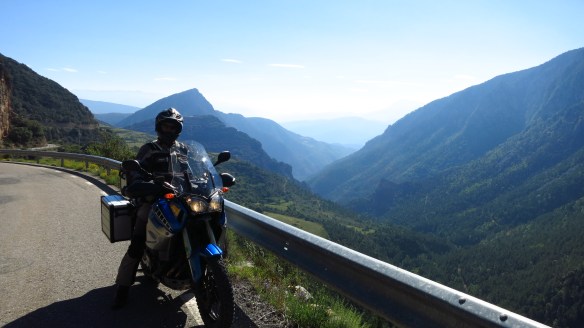
IMG_3543

At the top, the road does continue down to the French side, but it is only a gravel road. It was in quite good condition, and it descended – sometimes steeply – down to the village of Las Illas. Here I had several opportunities to test – both intentionally and accidentally – the ABS system. I have read a lot of complaints about it not being a switchable system, and how this limits the bike as an offroad machine. To that criticism I can only say two things. One – the system is incredibly well-judged, and I applaud Yamaha for having taken this approach. BMW chose to simply fit a switch and turn it off, Yamaha went to the trouble of designing a system that works really well offroad. I braked hard intentionally several times, and had to brake hard a couple of times when a car appeared the other way out of a corner, and at no point did I lose braking power. It only took a couple of bumps or a bit of gravel to leave my V-Strom without brakes. Two – if you are an offroad master (which I am definitely not) and really feel the need to switch the ABS off, then 55€ buy you a kit with a switch, the necessary wiring and a fuse, and I am sure you can make one yourself for less, so I do not think that the non-switchable ABS system is such a big deal.

IMG_3585

Over the next two days we spent half the time on and half the time off road. On the road the Super Ténéré behaved impeccably and never missed a beat, and offroad it was a revelation. I had changed the springs on my V-Strom to stiffer ones to cope with the weight and be able to do some offroading without bottoming out, but it was a harsh ride on tracks – the front end bounced around and I had to fight it to keep it going in the right direction, and the back kept losing traction for the same reason. I had never ridden anything other offroad, and I just thought this was the way you were supposed to do things… This bike opened my eyes – longer suspension travel and more sophisticated damping meant that it just soaked up the bumps, keeping the back wheel firmly on the ground most of the time, and the 270º crank engine behaves like a big single, sending the power to the back wheel in pulses to keep traction. It climbed through dirt track tight hairpins in the heart of the Pyrenees practically at idle without any problems, I would definitely not have been able to do that in a Tiger 800. That said, sixth gear is tall enough to cruise the motorway relaxedly, good combination. The seat that was so comfortable on the road is quite narrow at the front end, and with the bars quite high, the position when standing on the pegs is almost perfect. I say almost because being on the tall side, I would prefer it a bit higher, but this is easily solved with a set of risers, which I will definitely be fitting in the future.

IMG_3569

So all in all, a very positive impression of the bike. Fit and finish is very good, it might not look as good as a BMW, but when you look closer you see that Yamaha has spent the money where it counts, making a tough, functional bike for actually riding, not posing. Everything has been cleverly design, and it seems to be very user friendly if you want to do your own maintenance. The shaft drive does not bear such strong loads as in a GS, as there is an arm on the other side to distribute forces, meaning that it is very likely to be a lot more reliable, and coming from a chain driven motorbike, I did not notice any strange reactions when accelerating nor braking, making the Paralever system look unnecessarily overdesigned and failure-prone. It sure looks nice, but I want something I can ride with total peace of mind.

Summer holidays are coming, and there are at least two trips planned for the bike, which means that it will be due for a service when it comes back. I plan to do it myself, so I will let you know how easy or difficult it is.

The good:

  • Power delivery – plenty of grunt down low and still able to deliver a good kick at higher revs.
  • Very comfortable riding position and seat, still good to ride standing.
  • Good offroad behaviour.
  • Long service intervals, seems easy to service (to be confirmed).
  • Good gearing – sixth gear is good for the motorway, first gear is low enough for offroading, torque helps, and when it is not low enough, having a wet clutch works better for slipping than BMW’s dry one.

The bad:

  • Poor wind protection from the stock windshield – buffeting in the helmet and shoulders. I need a taller screen.
  • Abrupt off-throttle action – the bike is a bit jerky when completely closing the throttle. Not a big issue, but it can get annoying in start-stop traffic.
  • No gear indicator


Edited: a few months later, back from the Normandy summer trip, this motorbike was stolen right from my front door.

One last ride

So, new motorbike. What about the last one? Unlike owning a car, one of the many great things about motorbikes is that there is a very active second hand market, so it is easy to change bikes often and experience some variety. Not only that, it also means that there are lots of good bikes out there for sale and it is easy to sell yours and pay for a good chunk of the price of the next one.

The trouble was that mine was very special to me. It had been my first big motorbike and even though it started as a commuter bike it quickly graduated to weekend bike, short holidays bike, long holidays bike and finally adventure bike. It took me across Europe into Russia and Kazakhstan. To the Nordkapp and back down to the Adriatic. Across the Alps. Across the Pyrenees. Around Spain and Portugal…

IMG_1154

By the time the Yamaha came across and I decided to retire it, she had become a travelling companion and I had no intention of getting rid of it. I told myself that she was too old, that she had no real market value at almost 140,000 km, but that was just a poor excuse. I could break it apart and sell the parts, there is strong demand for V-Strom parts in Spain. I could also sell the accessories, I had spent a small fortune turning her into an adventure bike. But the truth was I just did not want to part with her. So I did what I knew I was going to do from the beginning – keep it.

So by the end of June I got her ready for her last trip – a trip down a route she had done many times before, a trip I had done countless times before her by car, a trip which had always been the very definition of driving and riding pleasure to me.

My late grandparents were born in a remote village deep in the countryside in a region that is very sparsely populated. Their house is still standing and we sometimes spend long weekends or holidays there, it is a wonderful place, quiet, beautiful and most importantly, with no main roads around. There are a thousand different back roads to get there from Barcelona, I have taken from five hours to two days to make the trip, and more than the time I spend there, what I really enjoy is the getting there.

My first long bike trip was there, it took me about six hours at a time I had not spend more than one hour straight on the bike. I had just bought her, and such a long trip was a daunting prospect, I had no idea how I would cope, or what I would do if I got too tired halfway. It was a blast. I fell in love with the bike, with riding, and I have not got off a bike ever since.

So with a place to keep her and a new excuse to make the trip from time to time to go visit her, we set off along those familiar roads one last time with her.

She did not feel old at all. Loaded with luggage for the weekend, all the spare parts and tools that were specific to her and I would no longer need for the Yamaha and a passenger, she could still keep a decent cruising speed and be fun on the windy bits. It was as if she was telling me ‘see? I can go on another 100,000 km, no sweat, I’m made for this’.

11888054_936788876382659_5627847432064108372_nI know V-Stroms can last longer than 140,000 km, but I did not want to ride her to the ground. I knew she still had a good few thousand kilometers left in her, my idea was to take her there and put her on long-term storage until I decided to use her again for future projects, and this little village was perfect – the climate is very dry, so I did not have to worry about rust.

Getting her into the house was a different matter… There is no garage as such in the house, just a basement that is accessible from the street through a backyard. Oh, and the house is not finished either… It is what you can call an ongoing project, it is not my grandparents house, but another one we bought some years ago. So when I got there I opened the old wooden door leading into the backyard to find it overgrown with weeds waist high. I paddled the bike across to the back door, the back tire spinning on the grass until I finally got her into the basement, only to find the next obstacle. I inched my way past construction tools and materials to reach two high steps that led to the only clear space where I could keep the bike, at the end of the basement. We used an old wooden plank with a brick under it to prevent it from snapping in two under the weight of the bike and succeeded in getting her up there.

Now, there are a series of procedures that have to be done to a bike in order to keep it store for extended periods of time, but it was a normal weekend which meant that we had get back to Barcelona the following day, and this time by bus, which takes much, much longer than by bike, so I just disconnected the battery and propped the bike up so that there was no weight on wither wheel. By mid August I would come back with everything I needed and prepare her for hibernation.

The following morning we called a taxi and it dropped us at the village where the bus stopped. It was more than ten years since the last time I had done the 8-hour journey back home by bus, and the combination of teenage memories and having let my bike behind made me feel quite melancholic as I enjoyed the views as a passenger again.

The bridge to nowhere

The town of Riba-roja in Spain is virtually at a cul-de-sac when it comes to road connections.

The C12 is a main road that leads up the river Ebro past Ascó, with its two nuclear plants, and reaches Flix, which a decade ago infamously made the news when it was revealed that the chemical plant there had been polluting the river with highly toxic mud, prompting a cleaning operation from which a dike built to try to contain the mud is still visible today. From there and to the north, the C12 eventually leads to the motorways connecting Barcelona and Madrid, the AP2 and the A2. To the northwest, a narrow road follows the river and the tracks from the Tarragona-Zaragoza train line up to Riba-roja.

mapa

The nuclear emergency plan for Tarragona, PENTA, called for an evacuation path to the north in case of an incident in the nuclear plant of Ascó. Flix has the C12, but the town of Riba-roja has nothing else than a narrow winding road leading west up the Serra de la Fatarella mountains, where driving faster than 30-40 km/h is impossible, meaning that the only escape route for the people of Riba-roja is to double back towards the nuclear plant to Flix to take the C12.

In order to solve this safety contradiction, a new road was planned. It was to cross the river Ebro at the far end of town and then lead north to Maials, from where main roads connect to Fraga and Lleida.

In 1997 a new bridge was opened. At a cost of 800 million of the old pesetas, it span 350 metres across the river Ebro to… nothing. Absolutely nothing was built on the other side of the river, meaning that the only practical use of the bridge was for the farmers to cross the river and easily access their fields on north bank without having to drive down the river to the nearest bridge in Flix. Handy if you live in Riba-roja and your apple trees are on the other shore, not so handy if you want to get the hell out in case of a nuclear meltdown in Ascó.

I had driven past that bridge several times, but as my route always took me to the small road up the Fatarella mountains, I had never paid any attention to what was at the other end of the bridge, until some months ago I heard about it on the news. Being the curious type, I checked out some maps and decided that the next time I was in the area I would cross this bridge to nowhere and see if I could somehow connect to Maials and then on to Mequinenza without having to go all the way around to Fraga. On the maps there seemed to be a network of paths and dirt roads on the other side of the river, the kind of thing that connects different farms and crop fields, so I figured that if I found the right way through them, I could make it.

So a few months later, here I was, on the northern shore of the Ebro, looking back at the bridge I had just crossed and taking some pictures of it for the blog. Standing under it, I fully appreciated what a huge thing it was, and what a huge waste of money it had been to build it and not finish the road connection on the other side.

DSC_0481

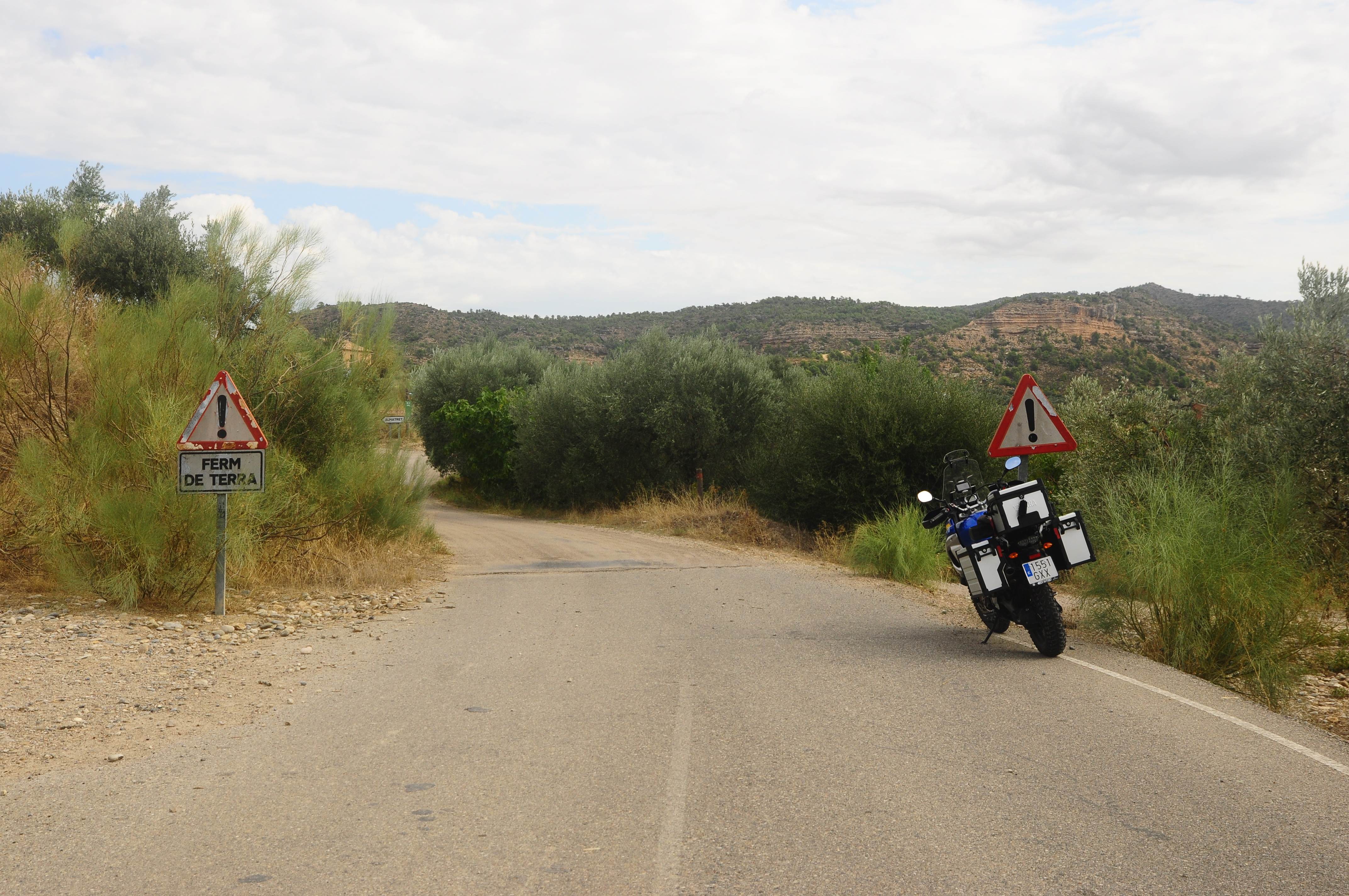
To my surprise, the road did not immediately end after the bridge as I had always heard, but it went on for about 500 metres where a road sign warned that the road was unpaved from there on. Strangely, it was not, it was just really bad tarmac, the kind that disintegrates into gravel and a bit further down the road I saw a sign that confirmed my suspicions that it was possible to connect to Maials – a sign that read ‘Almatret’ which according to the maps was a tiny village in the middle of the maze of dirt roads I had seen before.

DSC_0482

DSC_0483

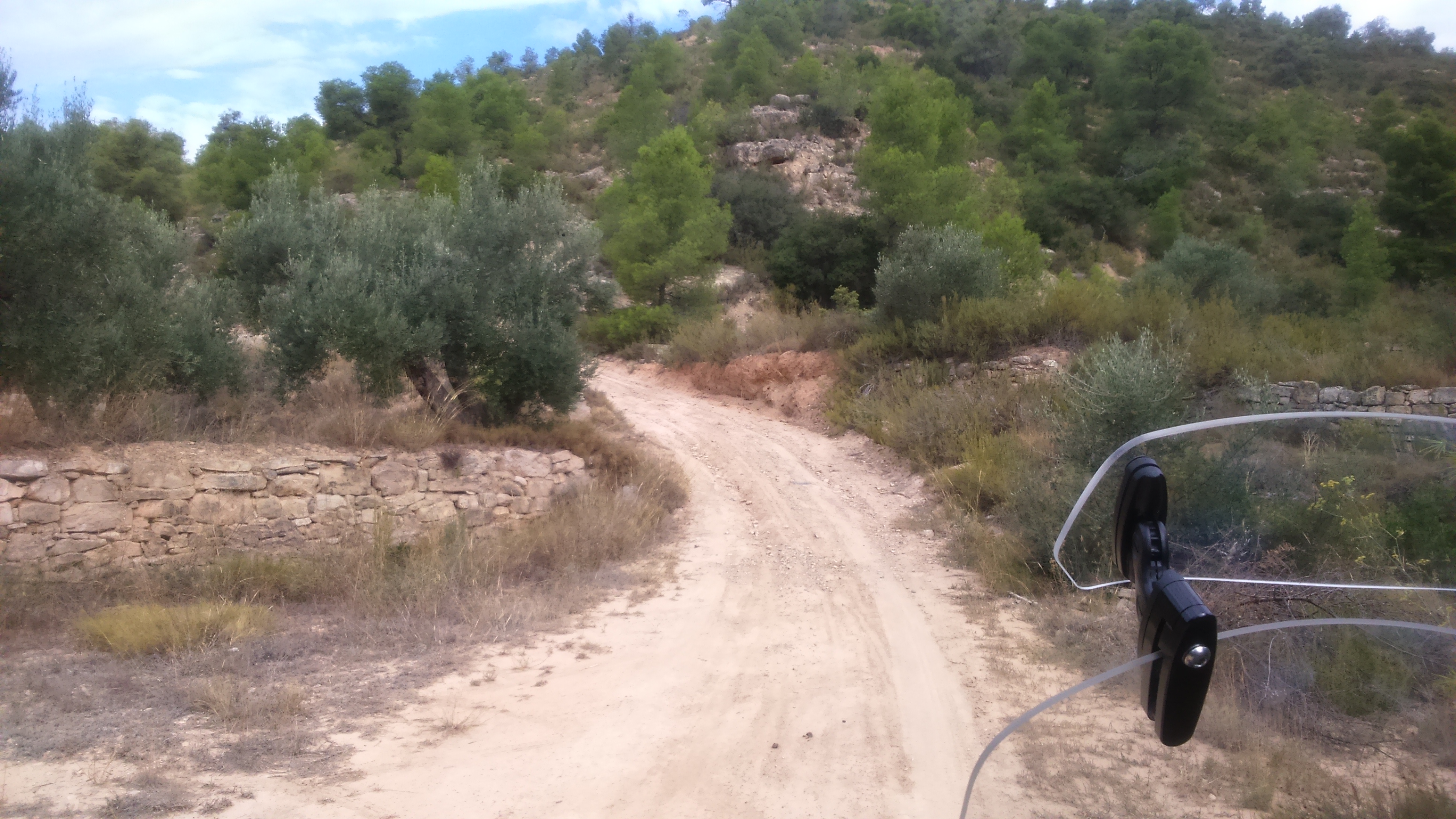
But things were not going to be so easy, after some kilometers of narrow desert road, the tarmac ended, and from there on it was only a kind of fire service road, the kind you need a proper four wheel drive to negotiate, not a car. I made my way carefully, as I was alone, on a heavy bike and with no phone signal on a road that barely anybody seemed to use.

DSC_0047

The path became steeper and steeper as it moved away from the river valley and up the mountain, and I was wondering how much further I would have to go before I found the village or things became too complicated and I had to turn around and go back to the bridge. Fortunately, the path seemed to have reached higher ground and it leveled off. In front of me I saw a farmhouse with a regular car parked in front of it, which meant that the road ahead had to be easier.

DSC_0489

It was. A few corners later I found good tarmac again, a road starting just outside the village I had been looking for. In the centre I asked an old shirtless man with a great round belly whether it was possible to connect to Mequinenza from there. I was glad to hear it was, and listened carefully to his directions, trying to remember the details. I left the village on a good road, heading for Maials, which I imagined was the road to which the bridge had to connect someday.

DSC_0048

There I was supposed to turn off to the left and find a dirt road leading to a place called La Granja d’Escarp. On the GPS the dirt road I was supposed to take seemed to be one of many between Maials and where I wanted to go, so before I got to Maials I decided to take a chance and turned into the first dirt road that looked in good condition.

Bad idea. I went into a maze of dirt roads that only deteriorated until they turned to small paths no matter which one I took. None of them seemed to lead anywhere, least of all the village I was trying to find. Not wanting to double all the way back because I had had to take the bike across some nasty bits of path, I followed the map the best I could to get back to the main road just past Maials.

To my delight, before I got there the dirt road led to a paved one and a bit to the west I came across a sign that pointed to La Granja d’Escarp. This was the road I had been looking for, I should have ridden past Maials instead of turning into the dirt roads before.

DSC_0049

Even though it was paved, it was little more than a dirt road with some tarmad on it, but it was way better than the paths I came from. After riding down a gentle slope for some kilometers, I arrived to La Granja d’Escarp, on the shore of the river Segre, which I followed south for a short while until it connected to the Ebro and I found Mequinenza.

DSC_0051

It had been an exciting ride, but I could not imagine that the route I had followed on dirt roads would be much help in case of a nuclear emergency, no matter how big the bridge was. Fortunately, the reason I had heard about the bridge on the news was that a project to complete the road had finally been revived and terrain and the environmental studies needed for the approval of the project carried out. Let’s hope Riba-roja is not in a cul-de-sac for much longer.

New baby

Ever since I finished the original Stroming the World trip I had been saying that I needed to change my motorbike. I bought my V-Strom second hand, thinking that it was my first big bike and it was going to get heavy use as my daily commute and sleep on the street, so it was a good idea to buy something cheap and reliable. It had about 40,000 km and at that time I had no idea that it was going to take me to so many places. By the time the trip was over the bike soon passed the 100.000 km mark back on her daily role as commuter bike and I was taking it everywhere – out on weekend trips, holidays in Corsica, pretty much everywhere in Spain… and I kept thinking that I needed to start considering a new one, for the old trusty V was already piling on too many kilometres.

What do you replace a V-Strom with? Usually the answer is “another one”. Nothing is as cheap, reliable and versatile as these bikes. Nothing. But I was now doing most of my trips two up, and I wanted something more powerful. For months and months I spent hours reading tests and reviews, trying to figure out what the best replacement was. I wanted something a bit more powerful, comfortable, just as reliable and with the off road ability that the V lacked, that is, better suspension and a bit more ground clearance.

I first looked at the same manufacturer – I had a very good relationship with my Suzuki dealer in Barcelona and I trusted the brand, after all my V had proven to be 100% reliable. I took a look at the 1000cc V-Strom, but a few things put me back. It was a new model, so there were still no second hand deals, which meant that it was just out of my budget, and it was quite road-biased – cast alloy wheels, not much ground clearance and not enough suspension travel increase over the 650. And not the prettiest girl in town, either.

The GS was another obvious answer to many, but the asking prices for second hand ones were just ridiculous, and the ones within my budget has astronomical mileage. And despite all their round-the-world, Long Way Round fame, a GS just did not inspire as much confidence as my V when it comes to reliability. Too many reports of final drive failures, electronic gremlins and lower general quality than my V. I kept reading a lot about “quality components” on the specialised press, but when I looked at how the plastics aged on a GS that had spent its life on the street compared to the ones on my V, I just did not perceive that famous quality. My bike is a workhorse, not a garage queen that is only ridden on sunny Sunday mornings, and I need it to live up to that task.

The 800 GS was interesting – much better suited to off-road duties, more power than my V for two-up riding, not as heavy, cheaper to buy and with a huge range of aftermarket extras. However, it suffered from three main problems. One – same patchy reliability record as her big sister. Two – ugly as hell; I did not fall in love with her, and you have to love your bike, it cannot be something you look at and think “it’s OK”. And three – the Porsche Boxter phenomenon. No matter how good it is, it still looks as if you couldn’t afford the real thing, a 911. This is the same, it’s just not a 1200 GS.

If I wanted more power, more off road ability and more fun, orange seemed the way to go. I had had a taste of Ilya’s 990 Adventure in Moscow and fallen in love with it. Second hand prices were very good too, at least in Spain, and it is definitely the queen when it comes to rough terrain. The problem is that Katies are 100% adrenaline 100% of the time. Great for adventure trips or attacking twisty roads at the weekend, not so great for everyday traffic, and while relatively cheap to buy second hand, they are frighteningly expensive to run. Fuel consumption can be ridiculous in heavy traffic (I have to commute in and out of Barcelona every day), and a valve check is due every 12.000 km, which means taking half the bike apart every few months. No thank you.

IMG_7205

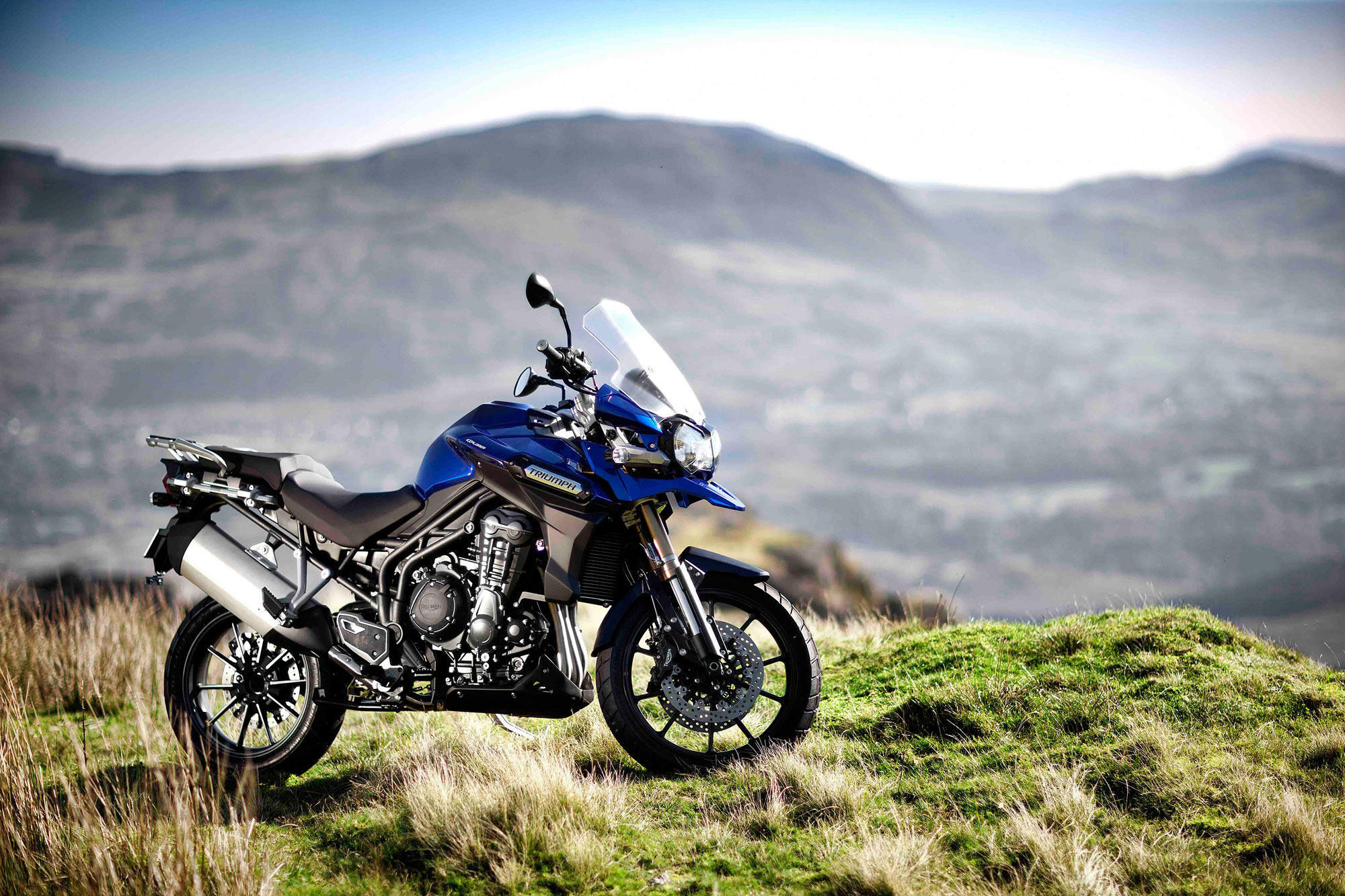
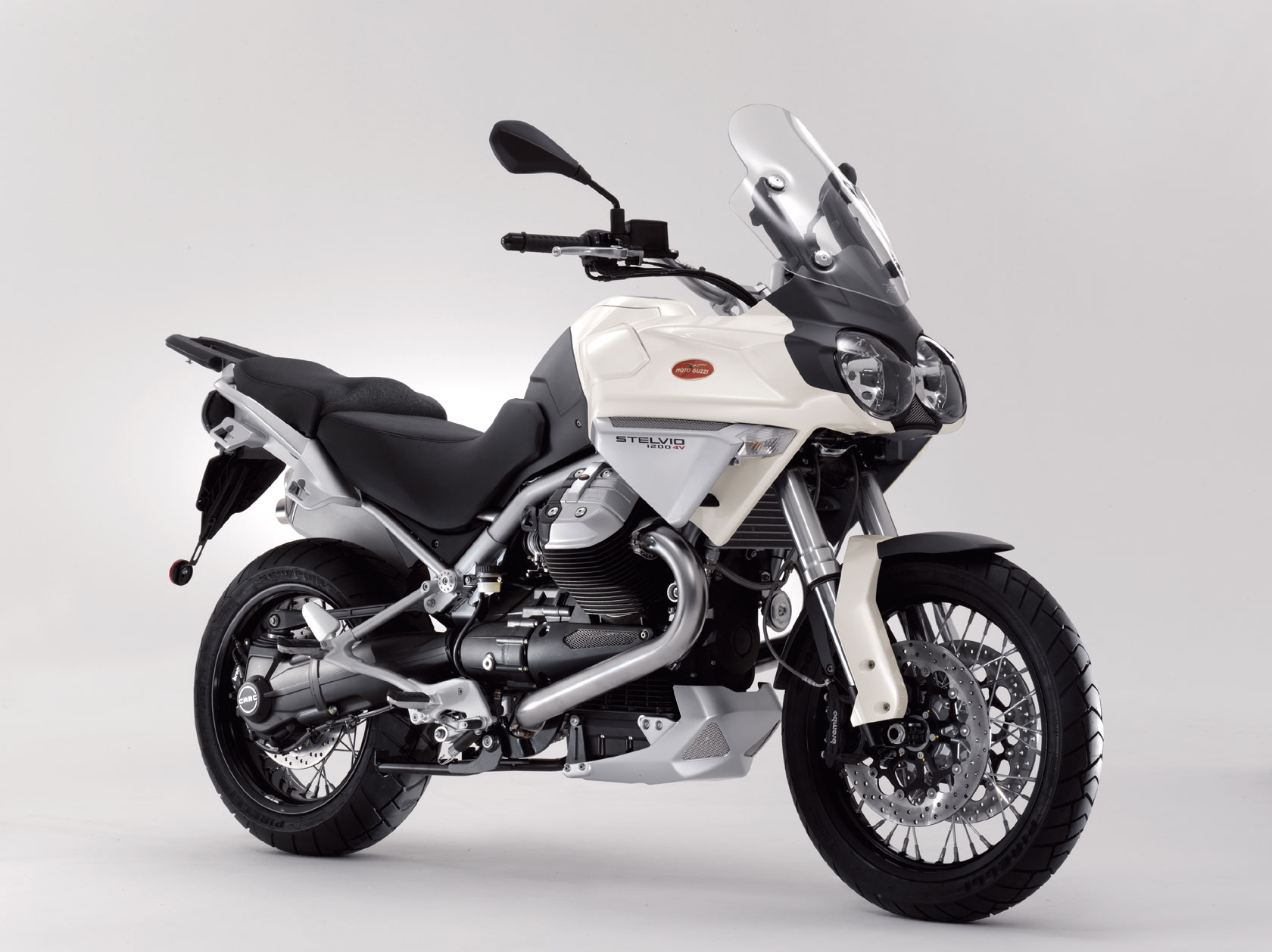
The 1200 Triumph Tiger Explorer was also out of the question, too expensive, as was the Moto Guzzi Stelvio, not only too expensive to buy new (very rare and therefore difficult to find one second hand) but with abysmal depreciation if I wanted to sell it on later.

That left two candidates that looked good on paper – the Triumph Tiger 800XC and the Yamaha Super Ténéré 1200. Both had wire wheels, good suspension travel and ground clearance, enough power for two people plus luggage and were easily available on the second hand market. The problem with the Yamaha was that it was still out of my budget, and the few units that I could afford were over 50,000 km – not such a high mileage as the GS, but still more than I wanted, and I was also worried about weight. The bloody thing weighs just over 260kg wet!

So, Triumph Tiger it was. I went to the dealer where I had found my second hand V and asked if they had any for sale. It turns out they did – an ex demonstrator, practically new, in black, very good deal. I was almost convinced that I had found my future bike, but then I took it for a test ride.

What a disappointment. I really liked the bike, it looked great, had good suspension, very good brakes compared to my old one and the legendary triple engine was smooth as butter. What did not live to the legend was the low-end torque. Everybody said that this engine was the best of both worlds – low end grunt like a twin, exciting at high revs like an inline four. Well, it wasn’t. Despite having 27 more horsepower it only had 16 more nm torque, and I kept stalling it in start-stop traffic in Barcelona. Some people argue that you just have to adjust to the clutch and the power delivery, and to be fair, when I was back in the city after a ride in the hills I did not stall it so much, but it still required more work and attention to ride in traffic than my V, and I just did not see myself using that bike daily, let alone negotiating difficult terrain. My feeling was that Triumph had designed a very good trail bike and then completely ruined it by fitting it with a road bike engine.

Back to square one, then… I kept riding my beloved V and started considering just replacing it with another one when it got too old, until I was invited to a wedding.

I once read some statistics somewhere about how many people find their future partners at weddings, and seems to be true. During lunch we were sat at the table with a friend of mine who has a 660 Ténéré and is good friends with one of the mechanics at the dealer he bought it from. We were talking bikes and he mentioned that they had a Super Ténéré for sale there. Only two things had put me off that bike before – price and weight. Other than that, it was the perfect one – Japanese reliability, powerful, very torquey, shaft drive (no more chain maintenance) and relatively economical to run. He told me the bike had been bought and serviced there and they knew it had a good history, it only had 13,000 km and they were asking the same as for the ones I had seen with over 50,000 km, so I went to see it the following weekend.

It turned out that the previous owner was a dentist and had bought the bike on a whim and only used it to go between his two clinics and once a year for a holiday in Mallorca. It was in mint condition and had all the accessories that came with the First Edition – aluminium engine guard, headlight guard, hand guards, heated grips and three original Yamaha cases, which unlike the Tiger, it meant that I had to spend nothing getting it ready to travel. The guy had decide that it was too much bike for that task and put it up for sale. So far, so good. Only one thing to do – test it. I needed to see how the engine delivered its power, if it vibrated much and how it handled its considerable weight.

I took it for a ride in the Collserola hills and fell in love with it within minutes. This was it. My new bike.

IMG_3450

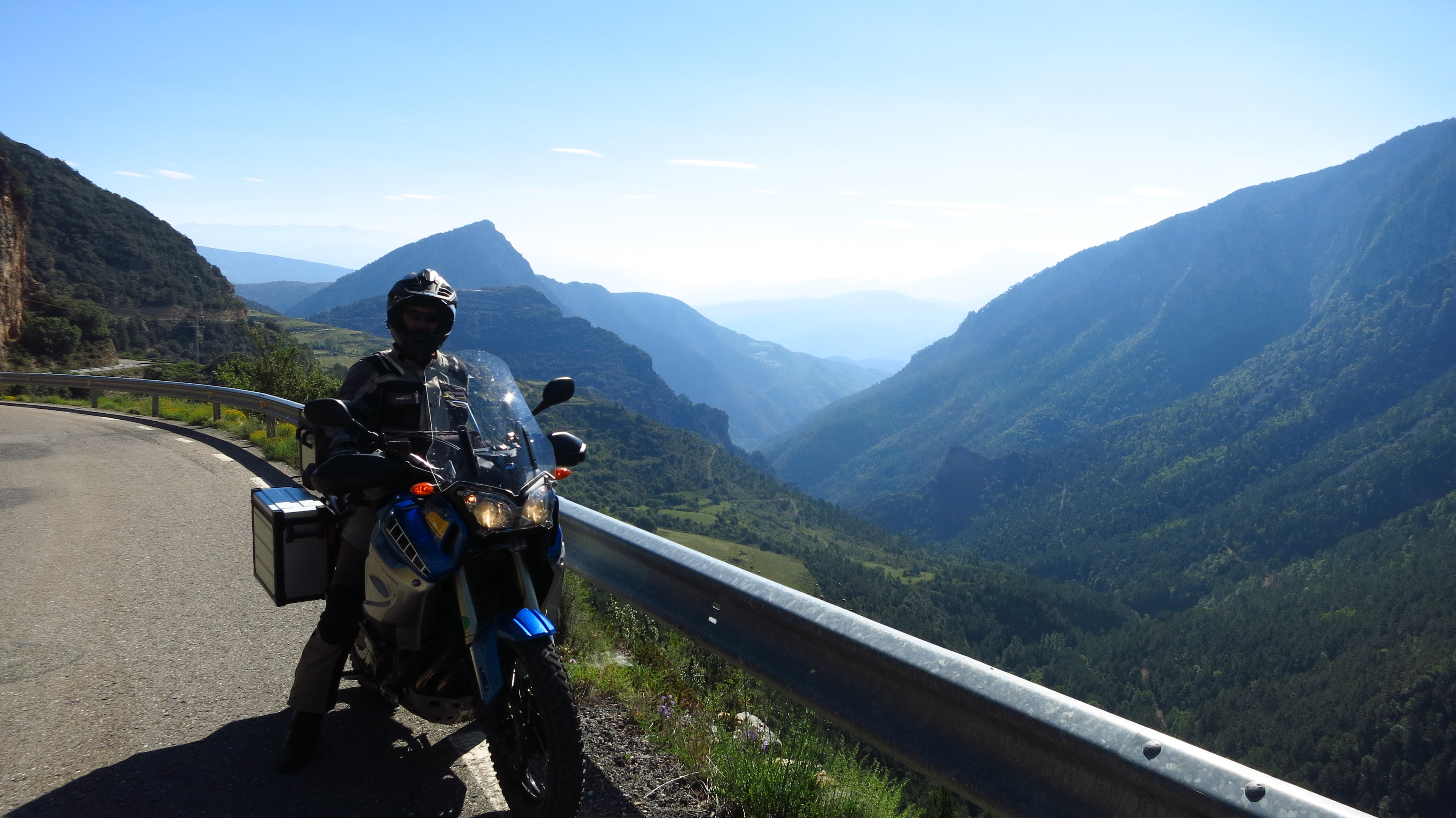
I paid a deposit, and a few days later picked up the new baby. A week later I went for a 4-day ride in the Pyrenees that combined roads and tracks to see what she was capable off and I was very impressed, but that is a story I will tell on a later post, together with a full review.

IMG_3484

So now, what about this blog’s name? It is based on the V-Strom name, after all… And what about the old bike? Well, the old bike is not retired yet… more to come soon.

Snow and paella

Day 10 – Monday 6th April – Sierra Nevada (82km) – [MAP]

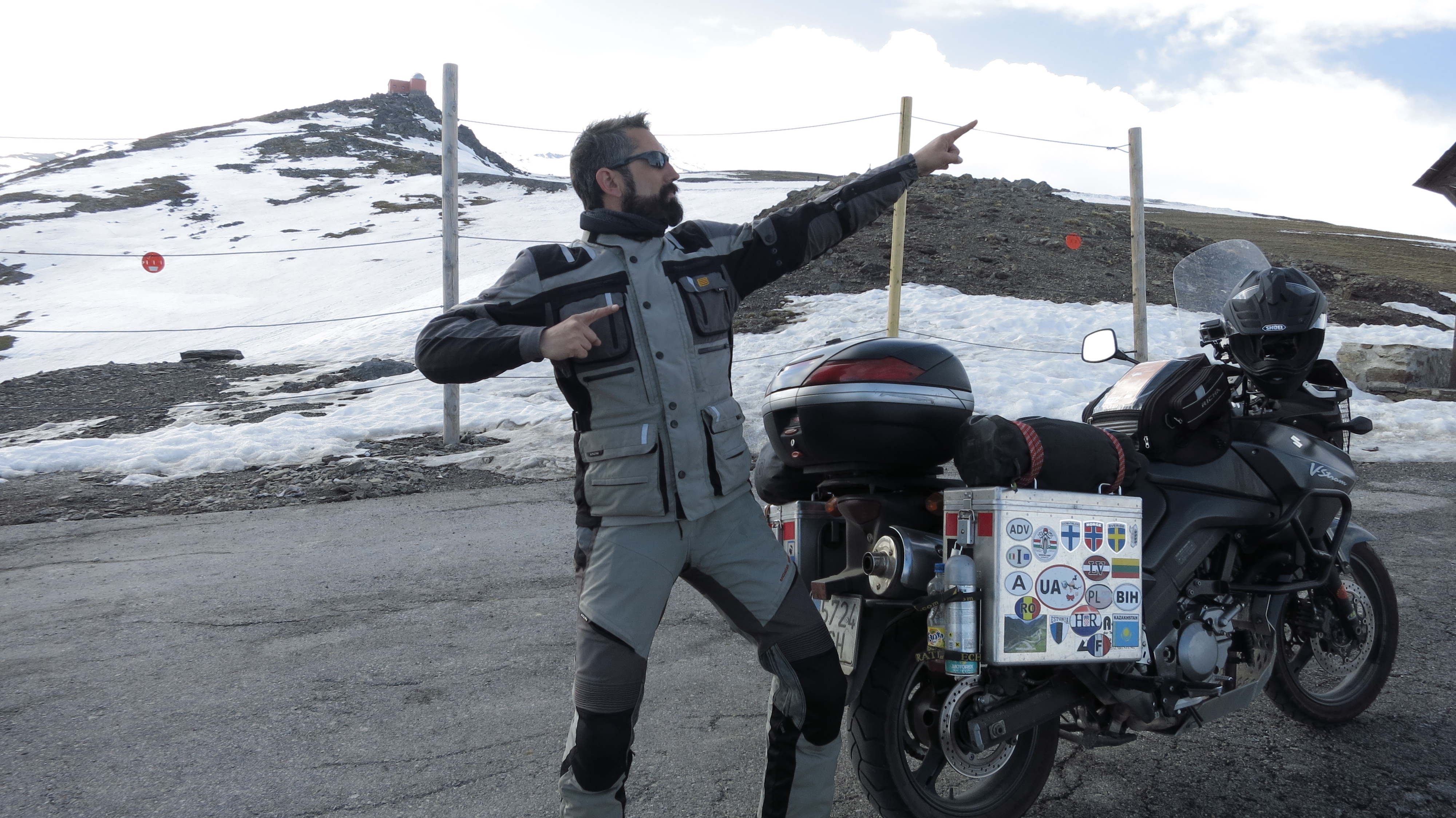
Sierra Nevada is the second higher range of mountains in Western Europe, only surpassed in height (by quite a lot, granted) by the Alps. It is quite an interesting fact when you consider its location, by the sea, in the south of Spain, quite close to Northern Africa. It leaves the Pyrenees in 3rd place by a meagre 78 metres, the 3,482m of Mulhacen against 3,404m of Aneto, the highest peak in the range that separates Spain from France. Being a mountaineer I find this fact a tad annoying, since it was possible to almost drive to the top of Mulhacen until 1994, when the road was closed to preserve the area, and still today its ascension has little to no difficulty, while the climb to Aneto is a long and technical affair requiring experience and physical preparation.

On the other hand, this meant that on this particular occasion, being on holiday as a biker and not as a climber, the range offered the opportunity to go from the warm and sunny bar terraces in Granada to the point where the road was closed, well above the snow line, in a less than an hour ride on a road that the Top Gear guys ranked along the Transfagarasan road and the Stelvio pass as one of the absolute best in Europe despite the fact that it led nowhere.

IMG_3229


The main road leads to Sierra Nevada ski slopes, which were still open at that time of year, and just before reaching the town of the same name at the foot of the slopes, a smaller road starts to the left, next to a car park for one of the ski lifts, which winds up the mountain to reach a Guardia Civil mountain station, where a boom across the road prevents unauthorised traffic to go any further. At this height, even if the boom had been lifted it would have been impossible to ride any further, as the road had not been cleared past that point and was covered in snow.

IMG_3233

We stopped there and walked up a bit further on the snow to see the sights of the ski slopes to one side and a breathtaking landscape on the other, stretching north as far as the eye could see.

IMG_3240

After taking some pictures we hopped on the bike again and rode back down to Granada to find the motorbike shop that worked with the transport company that was going to take our bike back to Barcelona. I tapped the address into the GPS and an hour later we stopped at their door, the temperature much higher than in the mountains.

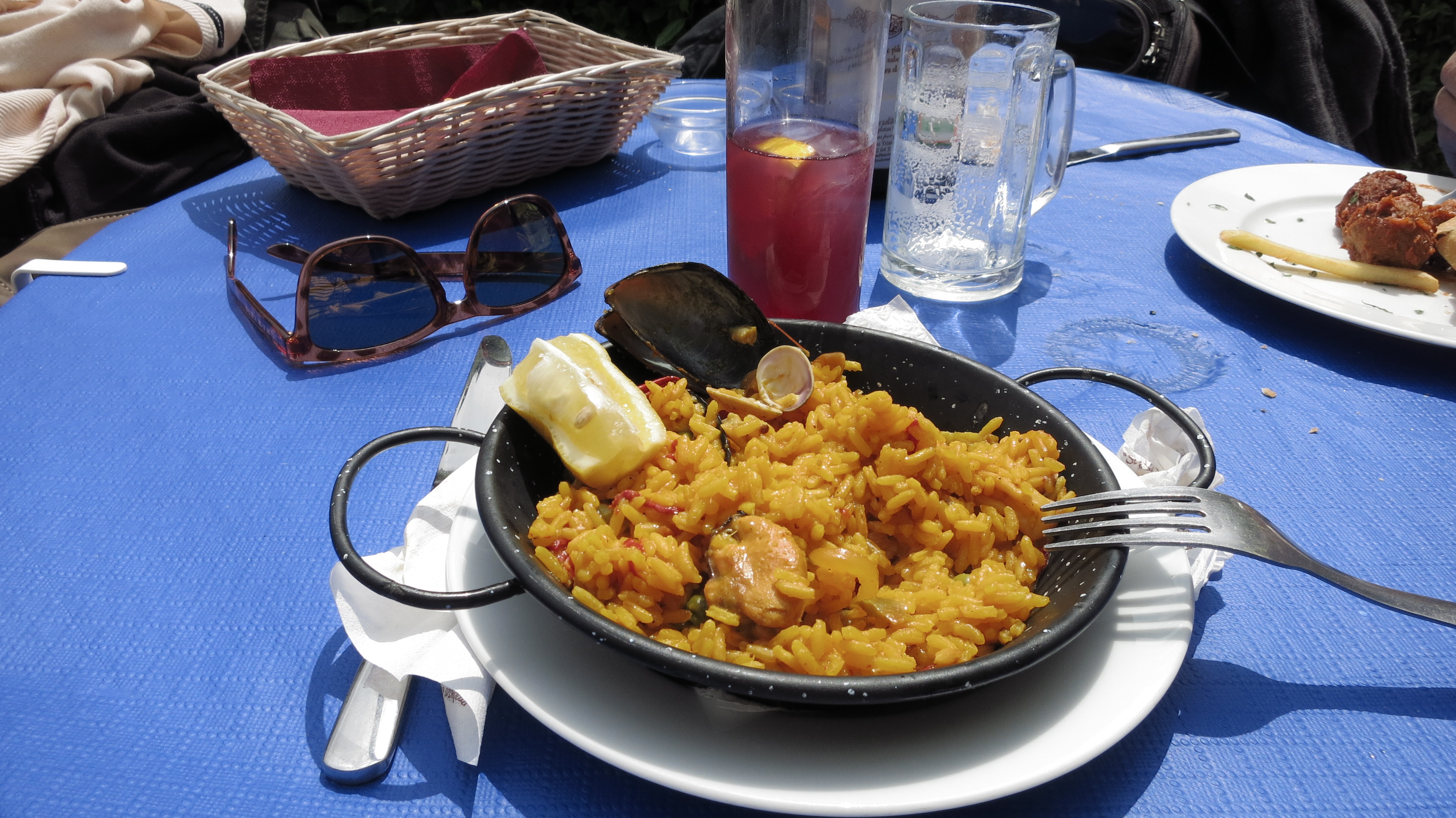
The place was called JMoto, and it was a Triumph dealer. Javi, the guy who ran the place, was really nice, and he let us get changed in the shop, as the plan was to send the riding suits, boots and helmets in the motorbike, take our luggage and fly home in civilian clothes. Imagine trying to board a plane in riding gear while carrying a helmet! I had to remove the sun visor from my new helmet and take it with me in my suitcase, but in the end everything fit in the top case and panniers. We signed some papers, gave Javi the keys, thanked him and said goodbye to our bike. It was now time to take a bus to the centre and find a good place to have that paella I had promised Nat.

IMG_3244

The good thing about a city like Granada is that, unlike Barcelona, it is quite difficult to go wrong when it comes to eating out. Make a mistake in Barcelona and you can easily end up in one of the many tourist traps that offer crap food at outrageous prices, but here everything was so good and so cheap, that any place seemed to be a safe bet. We found a nice restaurant with a terrace by the river, from which we had a nice view of the Alhambra while we ate, and spent most of the afternoon there.

After lunch we killed some time walking around the old town one last time and then headed to the centre to taste one last thing before heading to the airport: the local sweet specialty, a cake called Pionono.

While having cakes and tea I took the opportunity to bring my writing up to date – I had been writing very little in the previous days – and also to find out how to get to the airport. The taxis were bound to be expensive, and we discovered there was a shuttle service with a stop quite near where we were, so it was settled. We took the bus and 40 minutes later it dropped us at the airport.

The flight back to Barcelona was fast and uneventful, and the only thing I regret is that by the time we took off it was 10 pm and it was already dark, so I could not get one last look at Granada from the air. It had been 10 days on the road this time, I had seen some new places I knew little about, and in one way or another, each one of them given me great memories.

See you all on the road.

Hangover, tea houses and tapas

Day 9 – Sunday 5th April – Granada (0km)

The plan for Sunday was to get up early, take the motorbike and head up Sierra Nevada, see the sights from the mountains where the highest peak in the Iberian Peninsula is, then ride down to other side to the Almeria region, visit that and head back to Granada for the evening on some other mountain road, because on Monday I was dropping the bike at a bike shop from which I had arranged transport back to Barcelona and we would take that day to visit the city on foot. The problem, however, was that after the “one last beer” the previous night we had a tremendous hangover and we got up quite late… Not only that, after 9 days on the road I also fancied a couple of quiet day off the bike, much to Nat’s delight, so we decided to take it easy and just wander around the city.

A lot of people had told me about Granada and how much they had liked it, and I can tell that it more than met my expectations. It is a vibrant city with a lot to offer – there is a very active student life and night life, fascinating history, extensive cultural and architectural heritage, excellent food and atmosphere, inviting tea shops, quaint backstreets and alleys in the old town, and a general laid-back attitude that invites the visitor to take things easy.

IMG_3193

We spent the day walking around the narrow streets of the old town, went up the San Nicolás viewpoint high on the Albaicín quarter from which spent a good while gazing at the unforgettable view of the Alhambra, stopped here and there for a drink and some tapas, the afternoon turned into the evening and the endless string of tapas turned uninterrupted from lunch to dinner.

IMG_3214

We retired to the hotel relatively early, at least compared to the previous night, as we had decided to get up to an early start the following day and ride up to Sierra Nevada before taking the bike to the shop.